Modernizing Legacy Manufacturing Systems with IoT
Learn how manufacturers can connect legacy machines using IoT sensors, gateways, cloud dashboards, analytics, and phased modernization strategies.
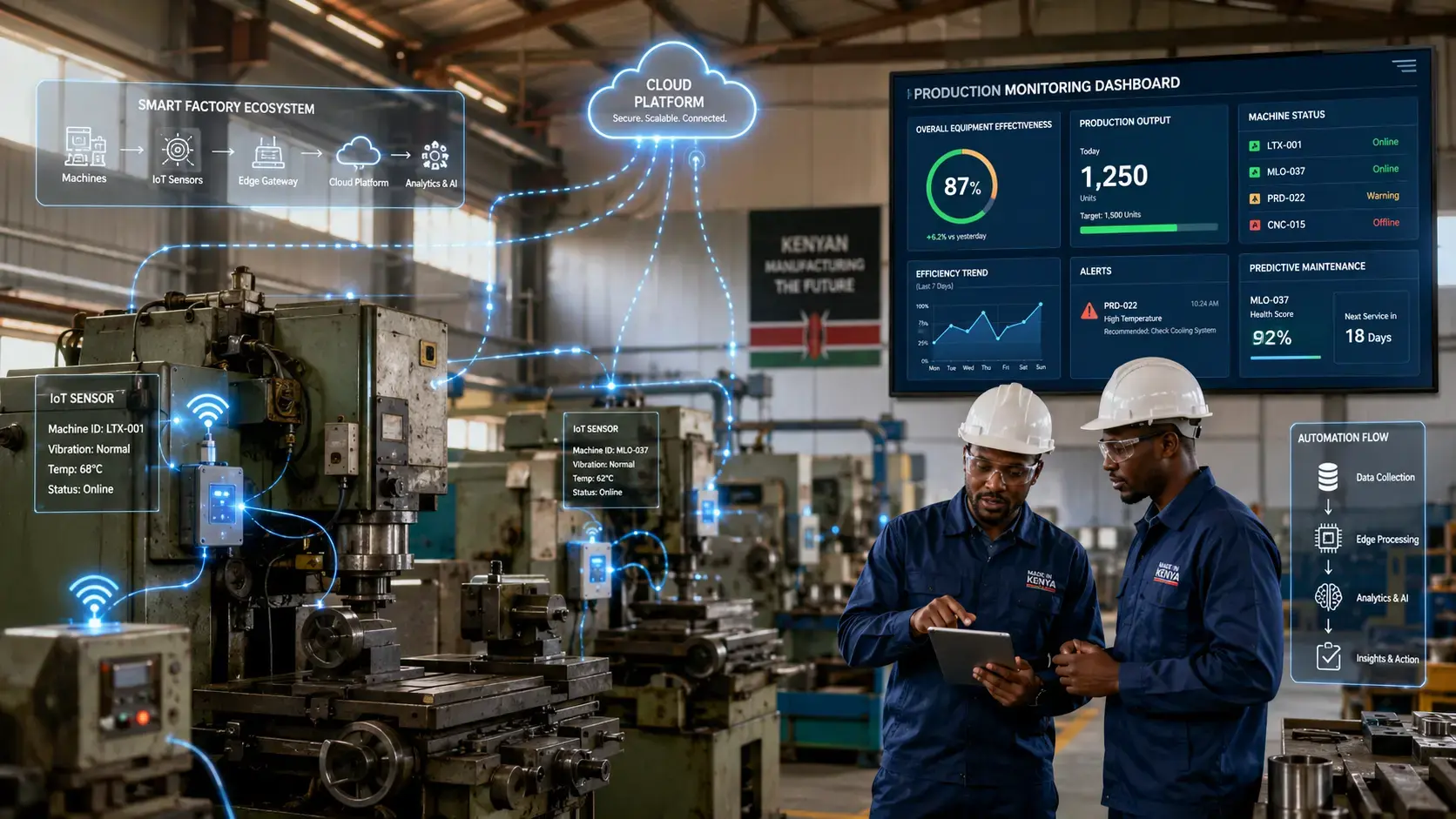
Many manufacturers still depend on reliable machines that were installed long before cloud platforms, real-time dashboards, and connected sensors became common. These machines may continue to perform their core production work well, but their data is often trapped in paper logs, isolated control panels, spreadsheets, or the experience of individual operators.
The Internet of Things, commonly called IoT, provides a practical way to modernize these legacy manufacturing systems without immediately replacing every machine. By adding sensors, gateways, secure connectivity, dashboards, and analytics, manufacturers can gain better visibility into equipment condition, production performance, energy use, maintenance needs, and operational risk.
What are legacy manufacturing systems?
A legacy manufacturing system is an older machine, production line, control system, or operational process that remains important to the business but was not designed for modern connectivity, data sharing, remote monitoring, or advanced analytics.
Common characteristics include:
- Manual production and maintenance records
- Standalone machines with limited communication capability
- Paper-based inspection and downtime logs
- Data stored in separate spreadsheets or local computers
- Limited visibility into machine condition between inspections
- Reactive maintenance after equipment failure
- Older PLCs, controllers, or proprietary interfaces
- Dependence on individual operator knowledge
Legacy does not necessarily mean obsolete. A machine may still be mechanically sound and productive. The real problem is often the lack of timely information needed to manage it efficiently.
How IoT connects existing manufacturing machines
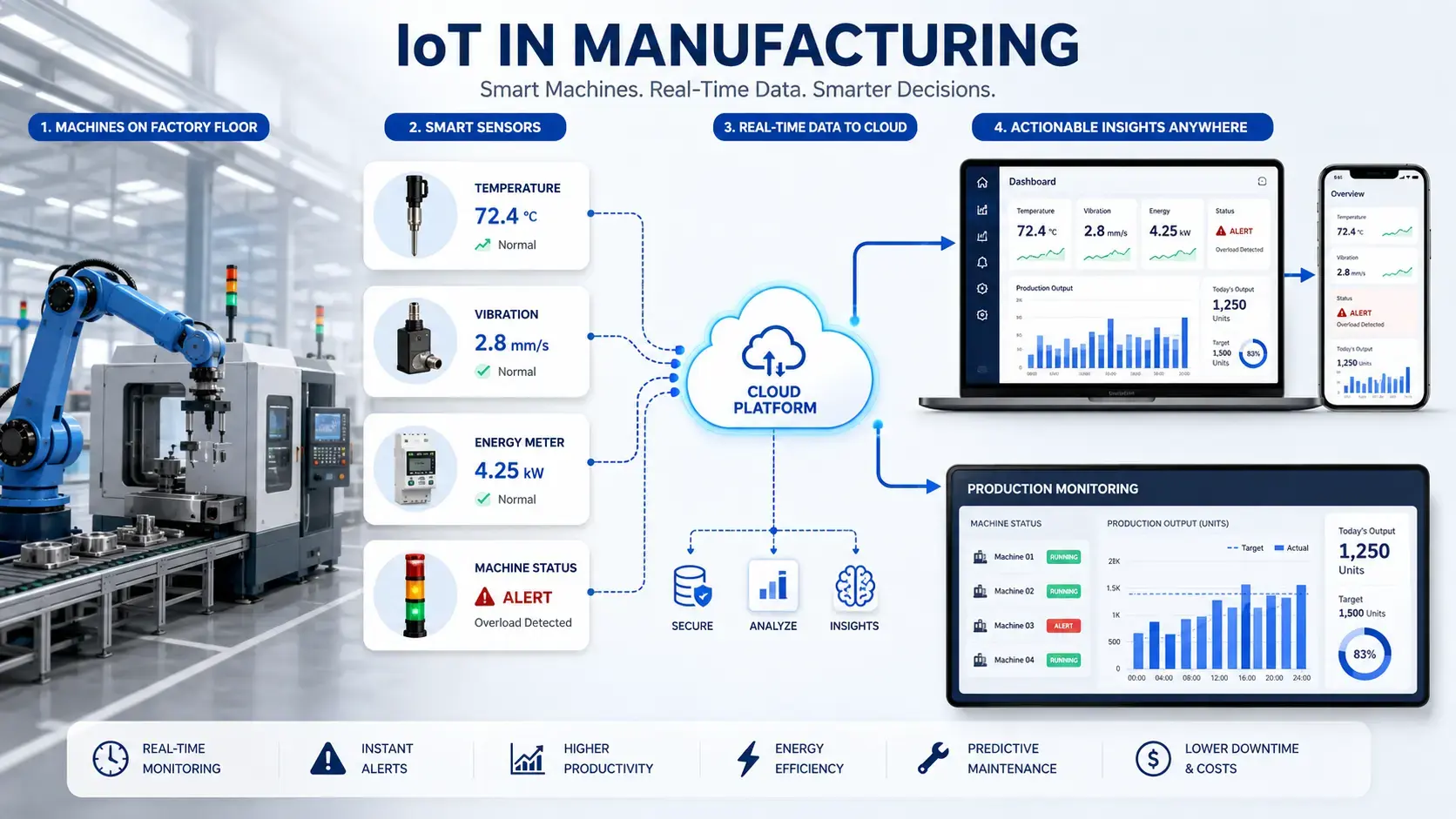
IoT modernization begins by collecting useful operational data from existing equipment. This can often be done without changing the machine's core control logic.
A typical flow includes:
- Machines and production equipment: existing assets continue performing their normal production functions.
- Sensors: temperature, vibration, current, pressure, energy, speed, flow, and other measurements are collected.
- Edge gateway: a local device receives machine or sensor data, filters it, and converts it into a usable format.
- Secure connectivity: selected data is transmitted through an industrial network, Wi-Fi, cellular connection, or other suitable channel.
- Cloud or local platform: data is stored, organized, and processed.
- Dashboards and alerts: managers, technicians, and operators view machine status, production output, trends, and warnings.
- Analytics and action: teams use the information to schedule maintenance, improve quality, reduce waste, and optimize production.
Modernization can therefore be incremental. A manufacturer may begin with one critical asset, one production line, or one maintenance problem before expanding the system.
Business benefits of modernizing manufacturing systems with IoT
1. Real-time equipment visibility
Instead of waiting for shift reports or manual inspections, teams can monitor critical operating conditions continuously. This makes it easier to identify unusual temperature, vibration, pressure, energy use, or machine status.
2. Reduced unplanned downtime
Early alerts allow maintenance teams to investigate developing problems before they become major failures. Even when predictive maintenance is not fully implemented, better condition visibility can significantly improve maintenance decisions.
3. Improved production performance
Connected production data can reveal cycle-time variation, idle periods, bottlenecks, recurring stoppages, and differences between shifts or machines.
4. Better energy management
Energy meters and machine-level monitoring can show where electricity, compressed air, steam, water, or fuel is being consumed inefficiently.
5. Stronger quality control
Process parameters can be linked with production quality records. This helps teams understand which operating conditions are associated with defects, rework, or inconsistent output.
6. More reliable maintenance planning
Maintenance decisions can be based on operating hours, machine condition, fault history, and production demand rather than fixed schedules alone.
7. Safer operations
IoT systems can support alerts for overheating, abnormal pressure, equipment overload, unsafe environmental conditions, or access to restricted areas. They support—not replace—formal safety controls and inspections.
8. Better management decisions
Dashboards and reports give managers clearer evidence when prioritizing maintenance, capital investment, staffing, process improvement, and production planning.
A step-by-step manufacturing modernization roadmap
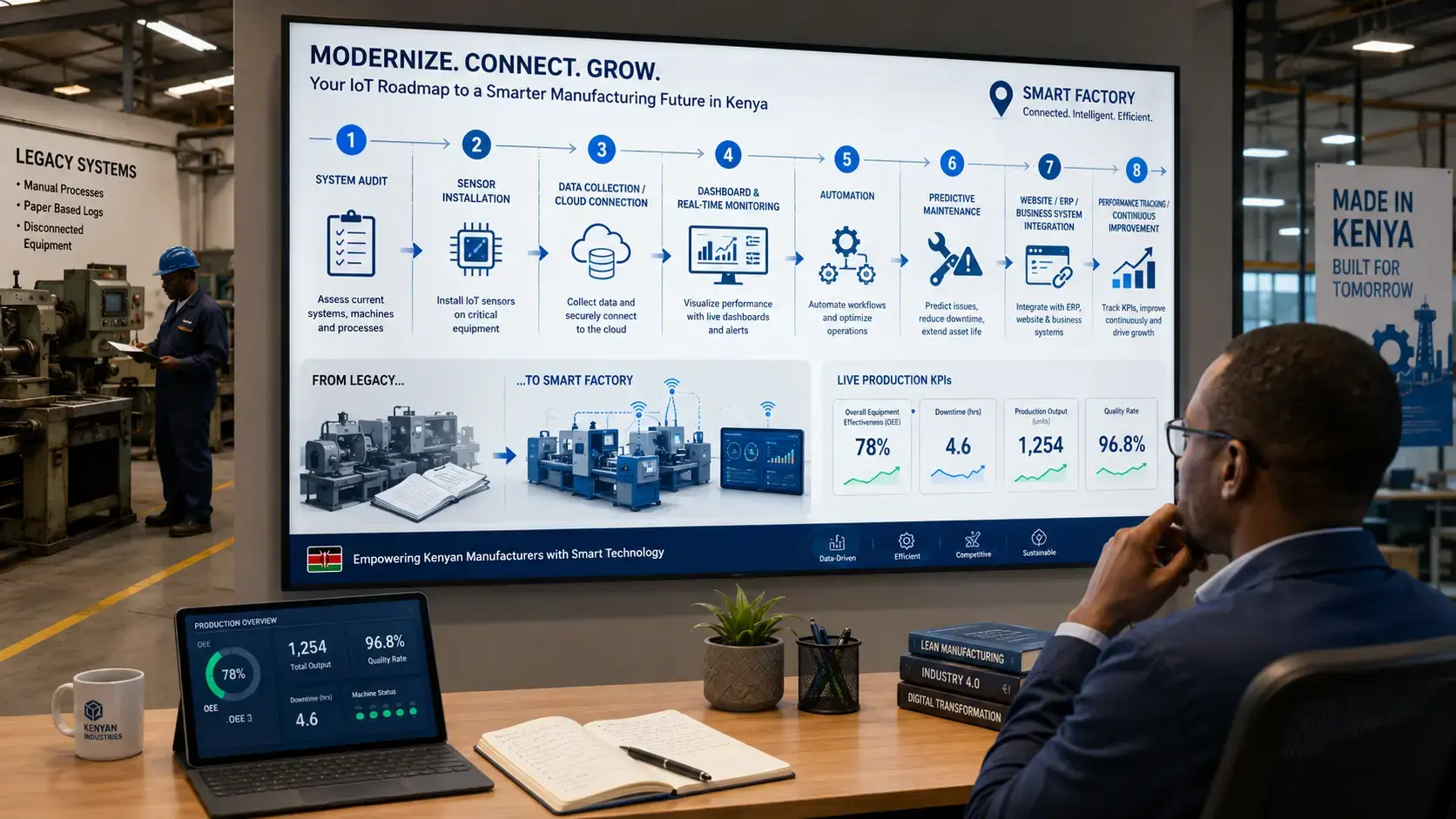
A successful IoT programme should begin with business and operational priorities—not with buying sensors.
Step 1: Audit current machines and processes
Document the machines, controllers, production processes, maintenance routines, available data, common failures, downtime causes, and current reporting methods.
Step 2: Select a valuable use case
Choose a problem with measurable impact, such as:
- Repeated bearing or motor failures
- Unexpected machine stoppages
- High energy consumption
- Slow production reporting
- Quality variation
- Manual meter readings
- Poor visibility into machine utilization
Step 3: Define measurable objectives
Examples include reducing downtime by 15%, improving overall equipment effectiveness, lowering energy use, reducing emergency maintenance, or shortening reporting time.
Step 4: Install suitable sensors and interfaces
The selected equipment may require external sensors, PLC data extraction, protocol converters, or industrial gateways. The solution should respect machine warranties, safety requirements, and control-system integrity.
Step 5: Build the data pipeline
Define how data is collected, transmitted, stored, cleaned, protected, and retained. Not every measurement needs to be sent continuously to the cloud.
Step 6: Design dashboards and alerts
Dashboards should answer practical questions. Operators may need machine status and alarms, technicians may need condition trends, while managers may need production, downtime, quality, and energy indicators.
Step 7: Integrate with existing business systems
IoT data becomes more valuable when connected with maintenance systems, ERP software, inventory, production schedules, quality records, or customer-order systems.
Step 8: Measure, improve, and expand
After a pilot proves useful, the organization can refine thresholds, train users, document procedures, and gradually connect additional assets.
Core components of an industrial IoT solution
Industrial sensors
Sensors collect measurements such as vibration, temperature, pressure, humidity, electrical current, speed, flow, sound, and energy consumption.
PLCs and machine controllers
Where technically appropriate, data may be read from existing programmable logic controllers, CNC controls, variable-frequency drives, or machine interfaces.
Edge gateways
Gateways connect machines to networks, translate industrial protocols, filter data, and support local processing when cloud connectivity is unavailable or unnecessary.
Communication protocols
Common industrial protocols may include Modbus, OPC UA, MQTT, Ethernet/IP, PROFINET, and vendor-specific interfaces. Compatibility must be assessed before implementation.
Cloud or on-premise platform
The platform stores data, manages devices, supports dashboards, performs analytics, and provides access controls. Some manufacturers choose on-premise or hybrid solutions because of connectivity, latency, or security requirements.
Dashboards and alerts
Useful dashboards present only the information required for decisions. Alerts should be prioritized carefully to avoid alarm fatigue.
Analytics and predictive models
Historical data can support trend analysis, anomaly detection, remaining-useful-life estimation, and predictive-maintenance models. These require reliable data and appropriate engineering interpretation.
Common implementation risks and how to manage them
Cybersecurity exposure
Connecting previously isolated equipment can create new risks. Strong network segmentation, access control, secure configuration, patching, encryption, and monitoring are essential.
Poor data quality
Incorrect sensor placement, calibration problems, missing data, and inconsistent timestamps can produce misleading conclusions.
Overcomplicated pilot projects
Trying to connect an entire factory at once increases cost and delays value. Start with one high-priority use case and expand after learning from it.
Lack of user involvement
Operators, technicians, engineers, IT teams, and managers should be involved from the beginning. A technically impressive dashboard may still fail if it does not support their real work.
Vendor lock-in
Where possible, use documented interfaces, open standards, exportable data, and clear ownership terms.
Ignoring change management
New systems alter how people inspect machines, respond to alarms, record work, and make decisions. Training, procedures, roles, and management support are necessary.
IoT opportunities for manufacturers in Kenya
Kenyan manufacturers face pressure to improve productivity, energy efficiency, quality, maintenance performance, and competitiveness while managing constrained capital budgets. This makes phased modernization particularly valuable.
Potential applications include:
- Monitoring motors, pumps, compressors, boilers, and refrigeration equipment
- Tracking energy use by machine, line, or production area
- Digitizing maintenance inspections and machine history
- Monitoring cold rooms and temperature-sensitive processes
- Connecting older CNC and production machines to dashboards
- Tracking production output and downtime
- Supporting water, steam, and compressed-air efficiency
- Building predictive-maintenance datasets over time
Manufacturers do not need to become fully automated smart factories immediately. A realistic goal is to create a connected improvement path where each phase solves a measurable operational problem.
When should a manufacturer consider IoT modernization?
IoT may be valuable when:
- Critical failures occur without enough warning
- Maintenance records are incomplete or fragmented
- Production reports take too long to prepare
- Managers lack real-time machine visibility
- Energy costs are high but poorly understood
- Machines are mechanically useful but digitally isolated
- Quality problems are difficult to connect with process conditions
- The organization wants to prepare for predictive maintenance
Conclusion
Modernizing legacy manufacturing systems with IoT is not primarily about replacing machines. It is about making existing assets more visible, measurable, connected, and manageable.
The most effective approach is phased: assess the current operation, select a valuable use case, connect the necessary data, create useful dashboards, integrate the workflow, measure results, and expand carefully.
When engineering, operations, maintenance, IT, and management work together, IoT can help older manufacturing systems support safer operations, better maintenance, lower downtime, improved energy performance, and smarter business decisions.
Frequently asked questions
Can old manufacturing machines be connected to IoT?
Yes. Many older machines can be connected using external sensors, industrial gateways, PLC interfaces, protocol converters, or non-invasive monitoring devices. A technical assessment is required first.
Does IoT require replacing the existing PLC?
Not always. Data can often be read from an existing PLC or collected through separate sensors without changing the primary control system.
What is the best first IoT project for a factory?
A good first project addresses a costly and measurable problem, such as repeated equipment failure, energy waste, production downtime, or slow manual reporting.
Can IoT support predictive maintenance?
Yes. Continuous condition data such as vibration, temperature, current, and pressure can support anomaly detection and predictive-maintenance models after enough reliable data has been collected.
Is cloud connectivity always required?
No. Industrial IoT solutions can be cloud-based, on-premise, or hybrid. The right architecture depends on connectivity, cybersecurity, latency, cost, and operational requirements.
Sources and further reading
Need a practical digital strategy?
We help organizations turn ideas, workflows, and growth goals into clear digital solutions.