
Why Most Business Websites Fail to Generate Leads: How Businesses Can Scale Online
Discover why many business websites fail to generate leads and how better strategy, SEO, performance, conversion design, CRM, and automation can support online growth.
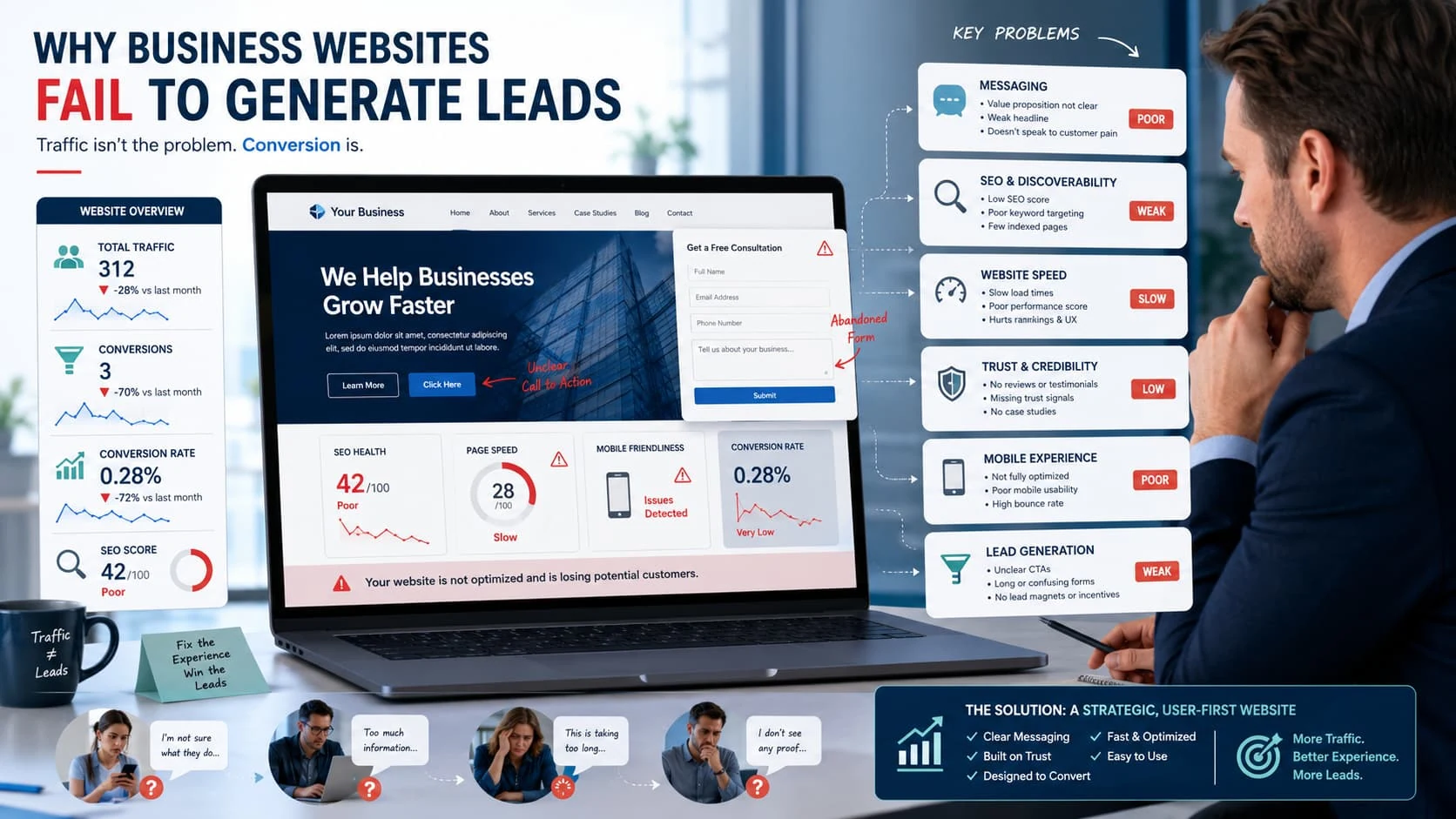
A business website can look modern, load correctly, and still fail to generate meaningful enquiries. This often happens because the website was treated as a design project rather than a business-growth system.
Lead generation depends on more than attractive colours and clean layouts. A successful website must attract the right visitors, communicate value clearly, build confidence, guide users toward action, and support consistent follow-up.
Why most business websites fail to generate leads
Traffic is not always the main problem. Many websites receive visitors but fail to turn them into enquiries because the experience does not give users enough clarity, confidence, or motivation to act.
The most common causes include:
- Unclear messaging and weak value propositions
- Slow page speed and poor mobile usability
- Low visibility in search engines
- Weak calls to action
- Forms that are long, confusing, or difficult to find
- Limited proof, testimonials, case studies, or trust signals
- Service pages that list features without explaining outcomes
- No clear follow-up process after an enquiry
- Disconnected marketing, CRM, and analytics tools
A website should answer four questions quickly: Who is this for? What problem does it solve? Why should the visitor trust the business? What should the visitor do next?
The missing strategy problem
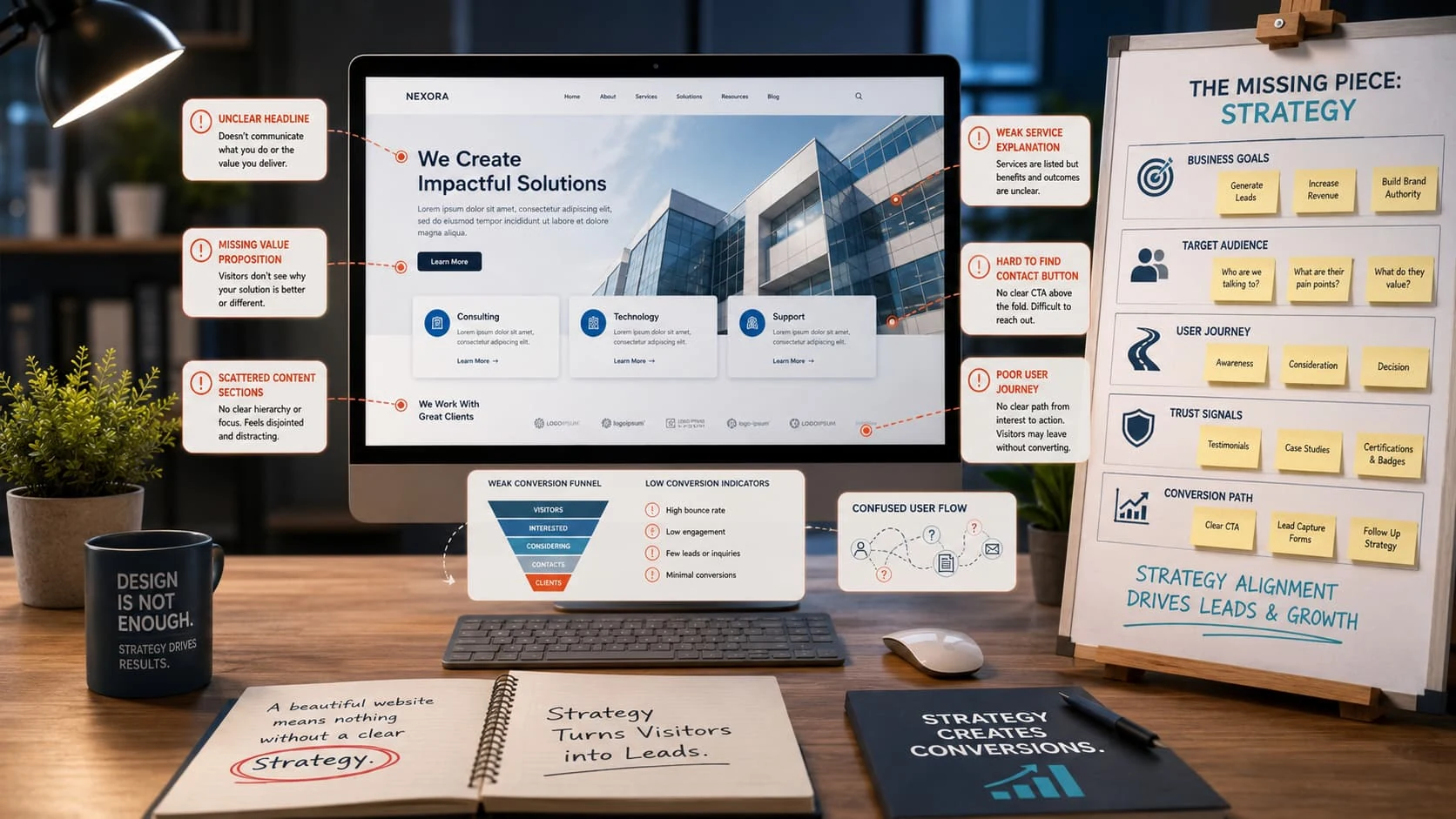
Many businesses begin a website project by choosing colours, layouts, and images. These decisions matter, but they should follow a clear business and conversion strategy.
Without strategy, websites often contain:
- Generic headlines such as “Welcome to our website”
- Long descriptions that focus on the company instead of the customer
- Scattered pages with no clear content hierarchy
- Several competing calls to action
- Service descriptions that do not explain measurable value
- No defined journey from awareness to enquiry
A useful website strategy should define:
- Business goals: generate leads, increase bookings, sell products, build authority, or support existing customers.
- Target audience: who they are, what problems they face, and what information they need.
- Value proposition: why the business is a strong and relevant choice.
- User journey: how visitors move from discovery to consideration and action.
- Trust signals: evidence that reduces risk and builds confidence.
- Conversion path: the exact action visitors should take and what happens afterwards.
Poor SEO and slow performance reduce lead opportunities
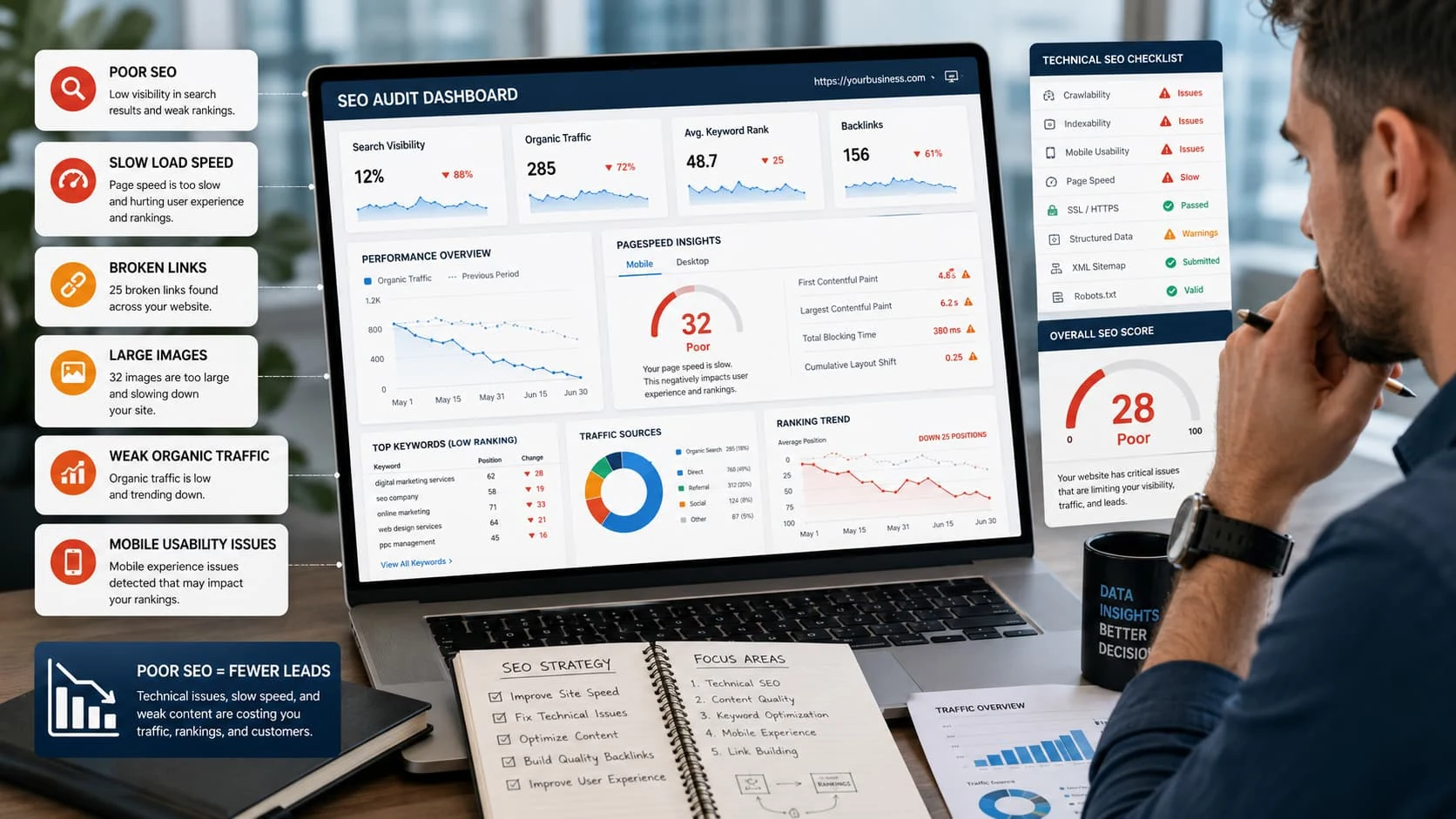
A website cannot generate consistent leads if potential customers cannot find it or leave before it loads.
Common SEO problems
- Pages are not optimized for relevant search terms
- Titles and meta descriptions are duplicated or missing
- Content does not answer real customer questions
- Important service pages are thin or poorly structured
- Internal links are weak or broken
- Local SEO signals are incomplete
- Search engines cannot crawl or index the site properly
Common performance problems
- Oversized images
- Too many scripts and plugins
- Slow hosting
- Unoptimized fonts and animations
- Layout shifts on mobile devices
- Broken links and outdated resources
Speed, technical SEO, and mobile usability affect both search visibility and user trust. Visitors often associate a slow or broken website with poor service quality.
Conversion and user-experience failures
Even a well-ranked website can fail if the user experience makes action difficult.
Weak calls to action
Buttons such as “Learn more” or “Click here” do not clearly communicate what happens next. Stronger calls to action include:
- Book a consultation
- Request a quotation
- Start your website project
- Schedule a product demo
- Download the guide
- Talk to a specialist
Complicated enquiry forms
Forms should request only the information needed for the next step. Long forms can reduce submissions, especially on mobile devices.
Weak trust and credibility
Potential clients may hesitate when a website lacks:
- Case studies or portfolio examples
- Testimonials or verified feedback
- Clear contact information
- Business location and service areas
- Professional biographies
- Security and privacy information
- Clear explanations of process, pricing, or timelines
Unclear service pages
Service pages should not simply list tasks. They should explain the problem, the solution, the expected value, who the service is for, what is included, and the next step.
How to build a website that generates leads
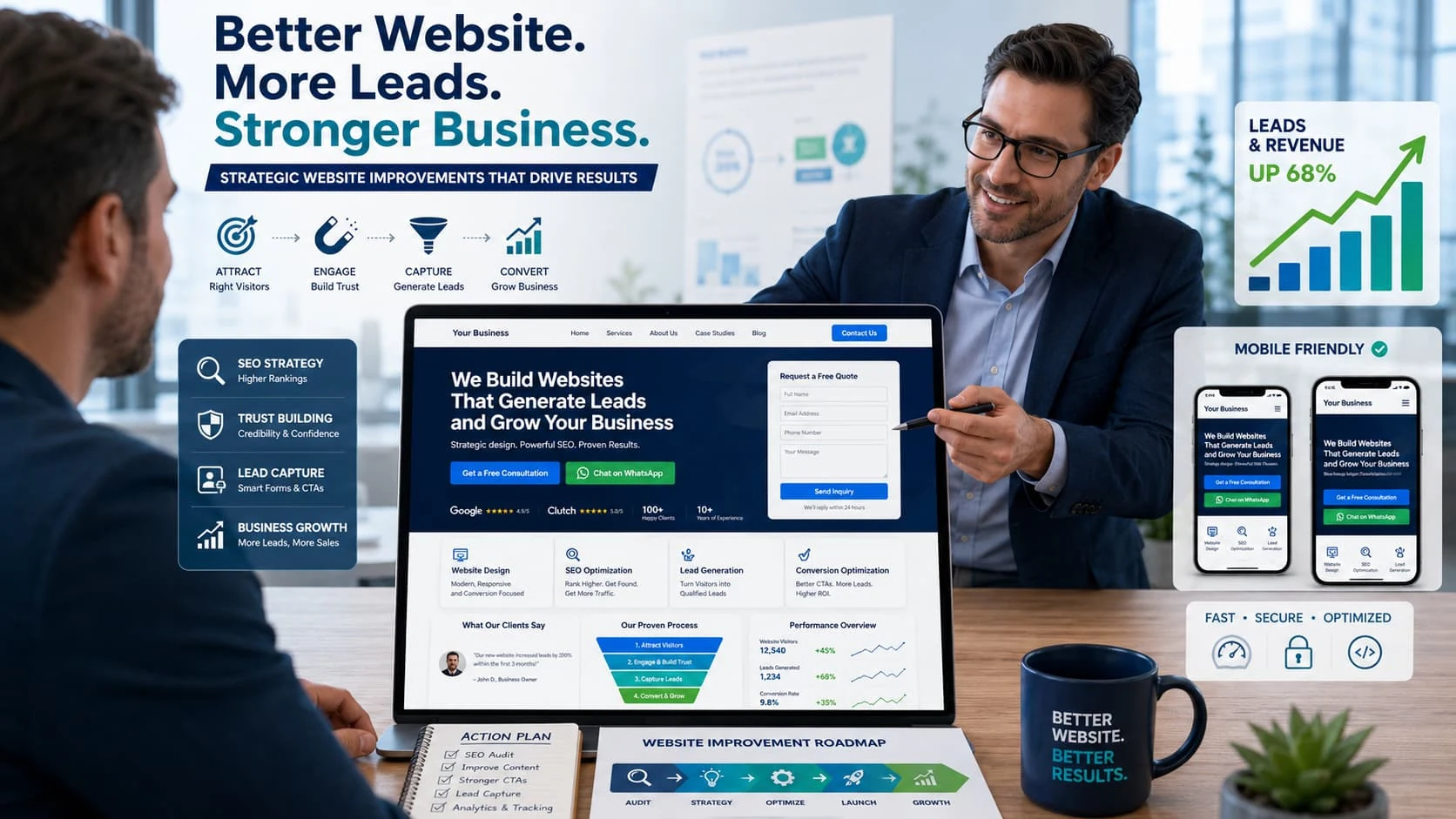
A lead-generating website works as part of a connected system.
1. Attract the right visitors
Use SEO, useful content, social media, referrals, email, and targeted campaigns to bring relevant audiences to the website.
2. Communicate value immediately
The homepage and landing pages should clearly explain the audience, problem, solution, and outcome.
3. Build confidence
Use proof such as project examples, credentials, client results, process explanations, guarantees, or relevant experience.
4. Create focused conversion paths
Each important page should have one primary action and a clear secondary option.
5. Use smart lead-capture tools
Forms, WhatsApp, bookings, live chat, and downloadable resources can support different visitor preferences.
6. Connect enquiries to follow-up systems
Website forms should connect to email, CRM, calendars, notifications, or task systems so leads are not lost.
7. Measure performance
Track:
- Qualified website traffic
- Conversion rate
- Form completion rate
- Calls and WhatsApp enquiries
- Cost per lead
- Response time
- Lead-to-client conversion
How businesses can scale online
Scaling online requires the website to evolve beyond a static brochure. As lead volume and customer needs grow, businesses may add:
- SEO-focused content and resource centres
- Dedicated landing pages for campaigns
- CRM and pipeline management
- Email nurturing and automated follow-ups
- Online booking and appointment systems
- Customer portals
- E-commerce and payment workflows
- Dashboards and analytics
- AI-assisted customer support and automation
The goal is not to add every tool. It is to create a connected digital platform that supports the customer journey and the internal team.
Stage 1: Fix the website foundation
Improve messaging, mobile usability, speed, SEO, navigation, and calls to action.
Stage 2: Strengthen lead capture
Add focused landing pages, better forms, consultation booking, WhatsApp, and clear service pathways.
Stage 3: Improve follow-up
Connect leads to CRM, email automation, reminders, and sales pipelines.
Stage 4: Use data to improve performance
Measure traffic quality, conversions, response times, and campaign outcomes.
Stage 5: Build scalable systems
Add portals, dashboards, automation, and custom workflows when standard tools are no longer enough.
Practical website lead-generation checklist
Review the following areas:
Messaging
- Is the main headline clear?
- Does the website explain the customer problem?
- Is the value proposition specific?
- Are services explained through outcomes?
Search and performance
- Are important pages indexed?
- Does the site load quickly?
- Are images optimized?
- Are mobile pages easy to use?
- Are technical SEO issues resolved?
Trust
- Are portfolio examples visible?
- Is contact information easy to find?
- Are policies and security information available?
- Does the site demonstrate relevant expertise?
Conversion
- Does every major page have a clear call to action?
- Are forms short and functional?
- Can visitors book, call, email, or use WhatsApp easily?
- Is the next step explained?
Follow-up and measurement
- Are enquiries stored and assigned?
- Are automated confirmations sent?
- Is response time monitored?
- Are conversions tracked?
Conclusion
Most business websites fail to generate leads because they lack strategy, clear messaging, search visibility, trust, conversion structure, or reliable follow-up.
A successful website should be designed around the complete customer journey—from discovery to decision and ongoing relationship. Businesses can then scale online by connecting the website with SEO, CRM, automation, analytics, portals, and other digital systems.
The most effective improvements are not always dramatic redesigns. Often, better messaging, faster performance, stronger service pages, clearer calls to action, and consistent follow-up create the greatest results.
Frequently asked questions
Why does my website get traffic but no enquiries?
The traffic may be poorly targeted, or the website may have unclear messaging, weak trust signals, confusing navigation, poor calls to action, or difficult forms.
How can I improve website lead generation?
Improve the value proposition, service-page content, SEO, page speed, trust signals, calls to action, enquiry forms, and follow-up process.
Do I need a complete website redesign?
Not always. A structured audit may identify specific improvements to messaging, SEO, speed, content, conversion paths, or mobile usability without replacing the entire website.
How important is SEO for lead generation?
SEO helps relevant customers discover the website. However, traffic must be supported by a strong conversion experience to produce leads.
What should happen after someone submits a form?
The visitor should receive confirmation, the enquiry should be stored or sent to the correct person, and a clear follow-up task should be created.
Sources and further reading
Need a practical digital strategy?
We help organizations turn ideas, workflows, and growth goals into clear digital solutions.